
When I was fourteen I wanted to be taller and faster. I’d been the skinny kid for all my school life up to that point, and I wanted to be bigger and to be able to win races. With a birthday just before the start of the New Year, I decided to combine the two and I resolved to grow as much as I could in the following year up to my fifteenth birthday, and to take up athletics to make me faster.
I embarked on a regime of exercise and a high protein diet which, based on my limited knowledge of nutrition science, I decided would make me grow taller. I took up running, joined a local club, and ate more eggs and chicken than ever before – my mother however drew the line at letting me eat steak on a regular basis.
I trained hard. Beginning in the winter months proved to be a good test. My coach, a local man named William Spratt (known to all as Bill), was supremely fit although forty years my senior, and he would make me train in all weathers. Three times a week I’d run a mile, meet Bill and we’d continue on a circular route for another two miles that would bring us back to my house and then he’d continue on afterwards back to his house – I worked out later that he knew the distance from my house to where we met, and that I’d run three miles each time, but he’d run twice that. I also found out that Bill had been the first Cambridgeshire man to run a marathon, and he was something of a local legend, although he never mentioned it. I felt very fortunate to have him as my coach. He was a tough coach though, more than once I phoned Bill on a training night to say “it’s raining hard” or “the snow is quite heavy”, followed by “shall we give it a miss?” – we rarely did, the only time he would agree was if the conditions underfoot were dangerous – either too icy, or compacted snow. Rain was never an excuse. During our winter training Bill decided I would run the 400 metres on the track in the summer season, as this would suit my leaner frame and he would make sure that my endurance levels were high enough for this demanding distance, which is run as a sprint.
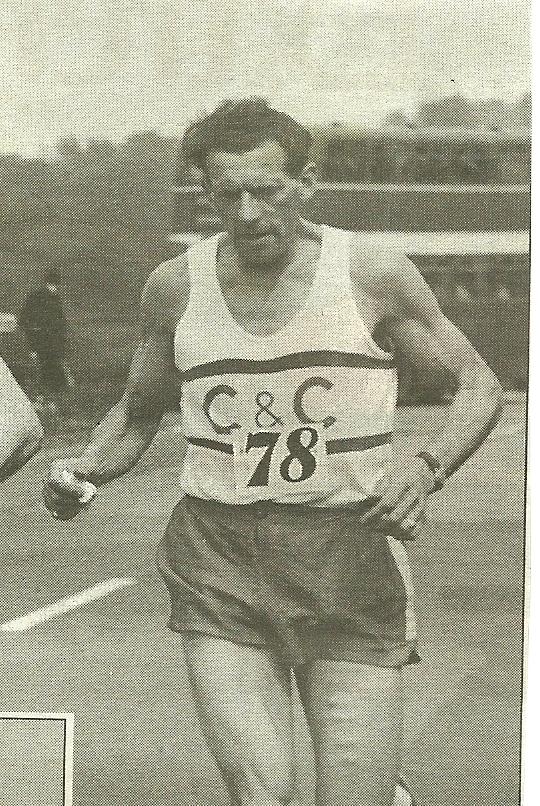
Bill – my athletics coach and mentor
On winter weekends Bill would take a group of us to train at our local woodland, where there was a steep incline of about 150 metres (not easy to find in the flatness of the fens!). He would drill us up and down this slope, in what he called a “pyramid”; this involved running up the slope as fast as we could, jogging back down, and repeating this in cycles of two, four, six, four, and two – in that pattern with no breaks in between. This was designed to push our endurance and build stamina.
Bill entered me for local and regional cross country races, I rarely finished higher than twentieth in a field of forty or more. I later learned that, as a 400 metre runner, I wasn’t expected to, but this was all designed to improve my stamina and also test my resolve. I have to admit that I did feel like giving up in a few races that went ahead despite driving snow, but I never did – Bill had taught me to run through the pain and the dips in energy and confidence.
Wednesday evenings were club meetings, the club was big, and the evenings were well attended by juniors through to veterans. I was one of the youngest, yet found myself training with a group a few years older than myself. We ran circuits around the streets near the club meeting place, and the drills were long and hard, but I loved drilling with the older kids, always trying to prove myself against them, seeing if I could keep up with the sixteen and seventeen year olds – of course I rarely could, but as my training went on I found myself only just behind their pace.
Around March of that year it was our inter-house school cross country. I’d told no-one, other than a close friend, that I’d been training, and then I entered the cross country – actually volunteering for it raised a few eyebrows! It was only a three mile race, so just the same length as my training runs. At the start I didn’t sprint to the front, I held off the pace a little, letting the usual boys surge ahead, but I didn’t let them get away from me. After about a mile I realised that this race was being run at a very slow pace, well below what I was used to in my training, I let it carry on that way for a few hundred yards more and then I just got bored of running so slowly, so I upped the pace, hit the front and before I knew it I was 100 metres ahead of them all. I recall my friend, who was racing too, shouting “go with him, he knows what he’s doing” – but nobody could, and I waited a good thirty seconds for the next person at the finish line. That was a good feeling, and I realised that just as I had resolved, I was becoming faster.
Then we got to the late spring, and the track season opened. We started training on a proper running track. It was the old fashioned cinder surface, most of which have since disappeared and have been replaced by the much friendlier tartan all weather surfaces, but I loved that cinder track, which gave me my first taste of running on a real circuit in spikes. We trained hard that spring, club nights were now at the track, although I kept my thrice weekly training road runs with Bill. At the track there seemed to be more people than ever, I was put into a group with four other boys, all a little older than me. We focused on sprint training, and more pyramids (this time on the flat though).
We trained hard all spring and into the summer. My legs had started to get very large, with muscly calves and thighs, and I remember my mother getting quite exasperated at the speed with which I was growing out of trousers – not just by height, but by the girth of my muscles. That summer I ran my very first competitive 400 metres, I finished fourth in a field of eight, and clocked a time of sixty seconds – which wasn’t a startlingly quick time, but at that age was not too shabby for a first race. Bill was happy. If Bill was happy, I was happy.
That summer, following my cross country victory, I was expected to take a clean sweep at the school athletics house competition. But I knew there was one boy that stood in my way, Martin Cleary. He was tall and fast. I’d never beaten him in a straight sprint at any distance. I discussed this with my mum, and I remember her saying to me , “David, have you not noticed how fast you’ve grown this year? You are nearly as tall as your father”. So absorbed had I become in my short terms targets that Bill had set me, that the cross country race had presented, and that weekly training had given me, with a focus on getting quicker, I’d forgotten about the first half of my resolution – to get taller. Of course, I had been able to control my running speed improvement; by sticking to a strict training regimen I had improved my endurance, my stamina and my speed – these were all variables that I was able to influence to a certain degree subject to my own discipline and dedication. What I could not control, was how fast I grew or how much I grew. As it happens between the ages of fourteen and sixteen I went from barely being five feet tall, to being almost six feet tall. At age fourteen and a half I was now taller than Martin Cleary. More importantly to me, I was now faster than he was, and I finally beat him! Later that summer I went on to run the 400 metres with my club in under 55 seconds, and progressed to county standard – I really had got faster! My personal best a few years later was 50.2 seconds.
The moral of this story from my own personal trip down memory lane? Well it’s quite simple really, what I did all those years ago, without even realising, was to make an ambitious resolution, only to have it broken down into more achievable shorter term objectives by my coach, who knew a lot more about how to achieve my goals than I did. If I had set myself the goal of winning the cross country, running under 60 seconds in the 400 metres, or beating Martin, then I doubt that I would have focused on the steps to get me there. Bill provided me with those steps. Maybe we all need a Bill, to keep us company as we work towards our grand objectives we set ourselves as New Year’s resolutions, it is the Bill’s of this world who have the wisdom to help us achieve those objectives stepwise. So if you are considering setting yourself a New Years resolution of losing weight, giving up smoking, eating a healthier diet, and so on, then don’t try and do it on your own – find your “Bill”, and you will stand a much higher chance of meeting your resolution.
As for growing taller, well I just happened to grow due to my genetic make up, so the lesson there is that there are some things we just have no control of at all, so don’t go wasting your time by setting totally impossible New Year’s resolutions – because if you don’t have the power to control the variables, then you cannot effect change.
So thanks Bill, you are long gone from this world, but you and the lessons you taught me are not forgotten.

 David Noble's Blog