
I have tried to write several blog articles about Christmas over the last few days, their content has been varied. I started with taking a look at the “commercialisation of Christmas”, but that just felt tired and cliched, and I found myself sounding very judgemental. Then I tried a different tack and started to write about “The meaning of Christmas” – an over used phrase I felt, that just pandered to peoples need to eat and drink to excess during the holidays. Again I ended up sounding judgemental. Finally I tried observational humour, recounting a few anecdotes of human behaviour that I’ve observed during the preparations for Christmas – mostly in the shops – but my humour began to sound, guess what, judgmental.
Time for some self-analysis I thought, after all I cannot let the festive season pass without making at least one post on my blog. So I asked myself this question: “why are you so judgmental about how people behave towards Christmas?’
The answer surprised me. That answer is quite simply because I regard myself as a Christian. I was surprised because I am not a very good Christian, regular church going lapsed a while ago, I don’t pray every day, and I don’t always got to church on the main days in the Christian calendar. A good friend of mine (who is now a vicar) once said to me, going to church makes you no more Christian than standing in a garage makes you a car – I’ve possibly taken that too far and have been part of the “non-churched” for quite some time.
But back to my not so Christian judgemental attitudes. I suppose I had not realised the strength of my own feelings about Christmas, and what it represents. There are many who argue that Christmas is overlaid onto older festivals, and will point to the historical process of how Christmas came to be celebrated in December, and how Yule and Saturnalia were there first. And that’s all interesting. But it’s not theological and it’s not spiritual, it’s just historical and the fact remains that we do have a festival called Christmas. It’s also not a good enough reason to sideline what Christmas celebrates; after all the name itself rather obviously has something to do with celebrating Christ; the title of this article “Cristes Maesse” is the old English meaning “Christ’s Mass”, which later became Christmas.
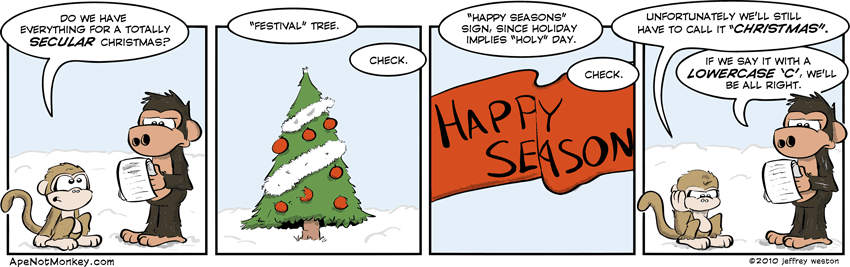
Secular Christmas
Illustration by apenotmonkey.com
Consequently the secular use and notion of Christmas (“Cristes Maesse”) sits uncomfortably with me, after all would society at large hijack Ramadan for its own purposes? Would the supermarkets make lengthy, cheesy, questionably distasteful commercials around Diwali? Would there be black Fridays and cyber Mondays geared around Hanukkah? And if the answer to these questions is ‘no’, then how has the Christian church allowed one of their two main celebratory days, the other being the resurrection at Easter, to be so secularised and taken over in this way? What if “Christmas” was a trademark or was copyrighted to ensure that it was only used by the church to refer to the celebration of the birth of Jesus, how different might that be? It is of course naive to think that we could divorce the secular and Christian celebrations of Christmas, so entwined have the traditions become over the years one can hardly see the join. But for Christians, Christmas is more than a holiday, it is a holy day.
As a Christian, and as cliched as it sounds, I really would like to see “Christ” put back into the celebration of Christmas. The fact that Christ, in many ways, has been displaced from how much of society celebrates Christmas is quite bizarre when you consider it in those terms. And that is precisely my point, there are few, if any instances, of secular society hijacking any other religious festivals other than the Christian ones of Christmas and Easter, and divorcing them from their spiritual and theological meanings. So why should Christmas be swallowed up by everything that is not Christian, and therefore not about Christmas? The birth of Jesus was arguably his first miracle, and it is the virgin birth that we celebrate on Christmas day, we give presents to each other to remind ourselves of the gifts the magi gave to Jesus to honour him, we sing carols that celebrate the manner of his birth – “O come all ye faithful, joyful and triumphant, come ye o come ye to Bethlehem”, is a call for the Christian faithful to make a spiritual journey in our minds to the time and place of Jesus’ birth, and we feast to mark the joyous significance of Jesus’ arrival. It is a true celebration of the birth of Jesus Christ. On December 25th Christians will celebrate that He has arrived
I hope that I have not been too judgemental of the secular, I have no objection to a secular holiday of course, but I hope that I have provided a small reminder that Christmas is supposed to be all about Christ.
Merry Christmas.

 David Noble's Blog