A Cooking Trilogy: Part One

“ ’Tis an ill cook that cannot lick his own fingers”

(William Shakespeare, from Romeo & Juliet)

I like to cook. And I like to write. So I’ve decided to use my next three posts to combine the two. I will provide a favourite recipe, with my own tips and modifications, a few illustrations and the reasons that I enjoy cooking and eating this particular meal.

I love that quote above from Romeo & Juliet, and although there is some subtext to it, the humour from the servant to Lord Capulet is obvious, he means that he can find more cooks by seeing if they will eat their own food, by licking their fingers during its preparation. This particular meal has me licking my fingers while I am making it:

Bubble & Squeak – Original recipe by Jamie Oliver

Take 1kg of good quality potatoes that will mash well, Maris Pipers are ideal. Peel, cut into smaller pieces to reduce the boiling time, and set aside.

Take 600g of mixed root vegetables, I use a combination of swede, carrots, and parsnips. Peel and chop. If you are using swede boil this for 5 minutes on its own, then add the rest of the chopped vegetables along with the potato. Salt the water if you like, but you’ll add seasoning later so not really necessary.

Once boiled sufficiently, so that the vegetables are soft enough to mash, add a handful of chopped curly kale to the saucepan for about a minute.

Now drain the vegetables and allow to steam dry for a few minutes, then mash, don’t be afraid of a few lumps as this will add to the texture. In the meantime, chop a handful of herbs; rosemary, sage and thyme are good, but whatever you have lying around will do. Heat two tablespoons of olive oil in a deep frying pan, add a generous knob of butter and when melted fry the herbs for a a minute or so.

Boil the vegetables until "mashable"

Boil the vegetables until “mashable”


Add the mashed vegetables to the frying pan, mix in the herbs and then flatten the vegetables so they fill the pan in a nice smooth “pancake”. Cook on a medium heat, and mix the vegetables every 3-4 minutes for 15 minutes. Add salt and ground pepper occasionally, and taste to get the seasoning balance just right (any little bits that happen to drop out of the pan pick up with your fingers and lick off!). You’ll find that the vegetables begin to catch the heat and brown on the underside – this is good, and adds to the flavour.
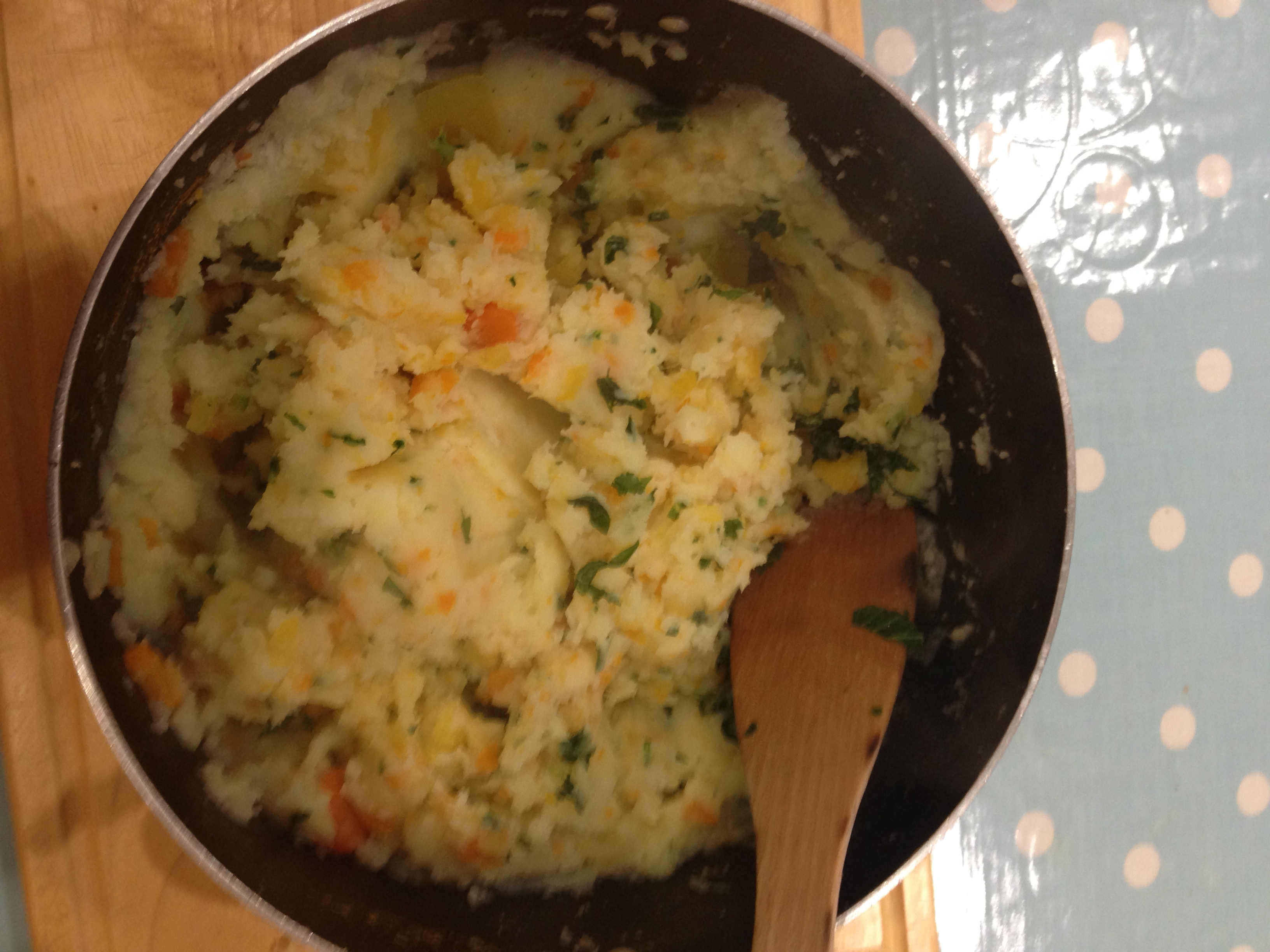
Mash the vegetables

Mash the vegetables


After 15 minutes, if you are brave, flip the bubble & squeak like a pancake – I am not brave, so I just invert over another frying pan. At this point the underside should have some nice crispy brown bits, mix these into the bubble & squeak, and repeat the process for a further 15 minutes. Sometimes you might need to add a little more olive oil if the vegetables have absorbed it all.
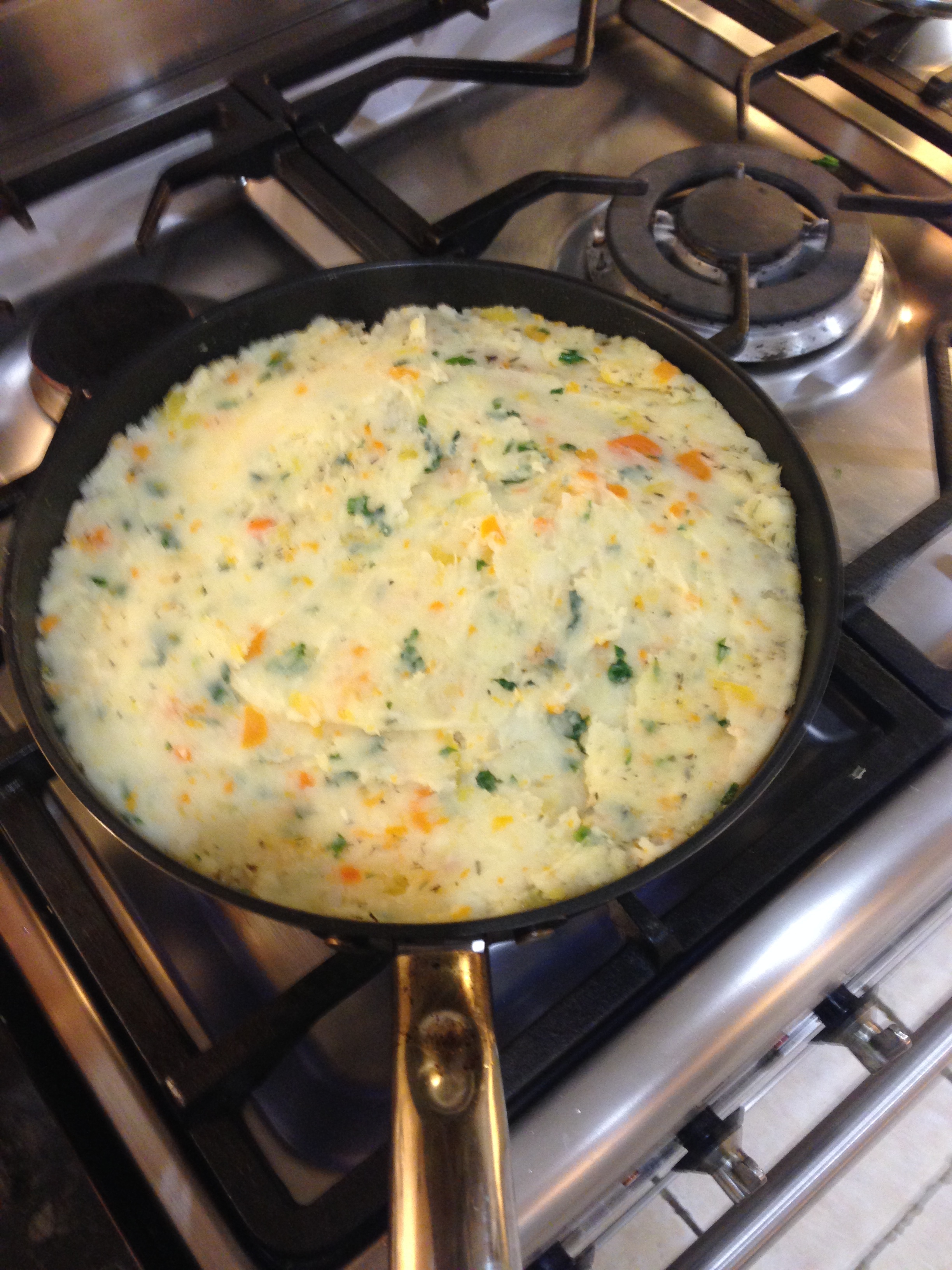
Flatten and turn in the frying pan

Flatten and turn in the frying pan

Mix and build up the flavours

Mix and build up the flavours


You are then ready to serve. Turn the bubble & squeak out onto a plate, allow your diners to cut their own slice and then crown it with a fried egg, yolk nice and runny. Supply plenty of brown sauce.

Ready to serve

Ready to serve


This is a perfect winter meal, it is hot and filling and tastes delicious. Any leftovers can be frozen, or just kept in the fridge for 2-3 days and eaten cold or heated – to be honest there is never any left to freeze in our house!

Why I like this recipe. 

It is basic, yet it involves some skill in building up the flavours. And the flavour mix is yours to decide. Each one you cook will be slightly different, as you’ll likely use different vegetables, or different amounts of the same ones. You can be quite creative with what you use.

It looks great when served, especially if you’ve got the right amount of brown bits on the surface.

There is something very British about bubble & squeak, this one is not made with leftovers as a traditional one would be, but it still feels quite authentic.

It is a hunger buster. Make one big enough (scales up easily) and a thick slice is very filling.

It is an easy vegetarian recipe, and can even be made vegan (just leave out the butter and the egg)

It is a great meal for sharing, everyone gets to dive in to get their slice.

It can be served as breakfast, lunch or supper – the choice is entirely yours.

Scraping the pan before you wash it up is the cooks privilege, and you get those crispy bits that stuck.

Coming in my next post: Tempura prawns, made gluten free.

A case of mistaken identity?

I am writing a novel. I’ve tried several times before and have at least three failed attempts to my name – failed in the sense that I gave up and lost interest and motivation. This time it is going to be different – at least that is what I have been telling myself. I am determined that it will be different, as I feel motivated to write and very inspired by my subject matter. I have my daughter Eve to thank for some of that inspiration, over the summer we have been to Stratford-upon-Avon – the birth place of England’s most famous literary son – William Shakespeare. Eve won a place on a course at the prestigious Royal Shakespeare Company (RSC), and I needed to be her chaperone. This meant that for a whole week while she was working I had time to myself to write in Stratford-upon-Avon. We stayed in a cottage in a street actually called “Shakespeare Street” – failure to find inspiration and motivation in such a setting was almost impossible.

Shakespeare Street

Shakespeare Street

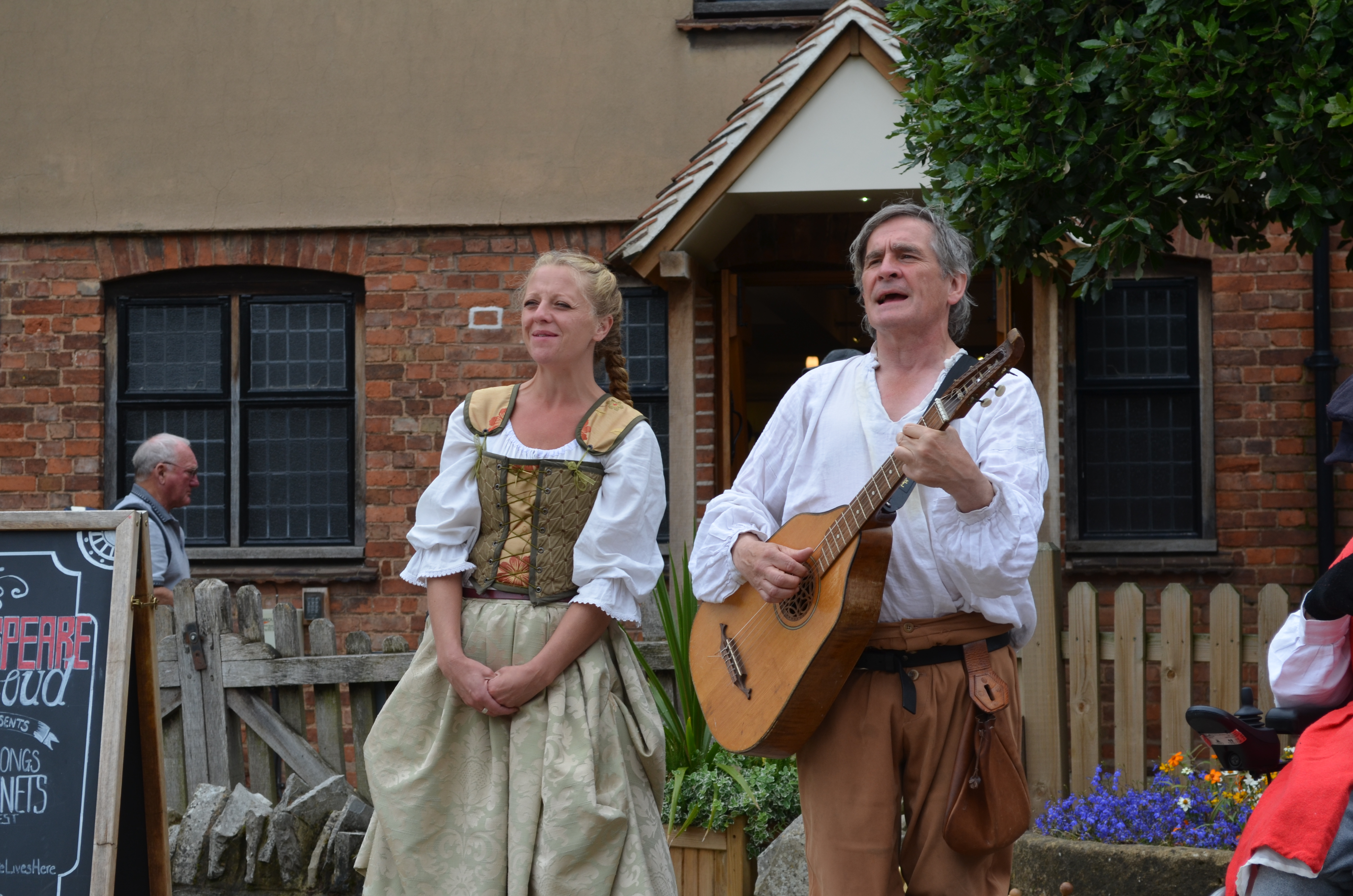
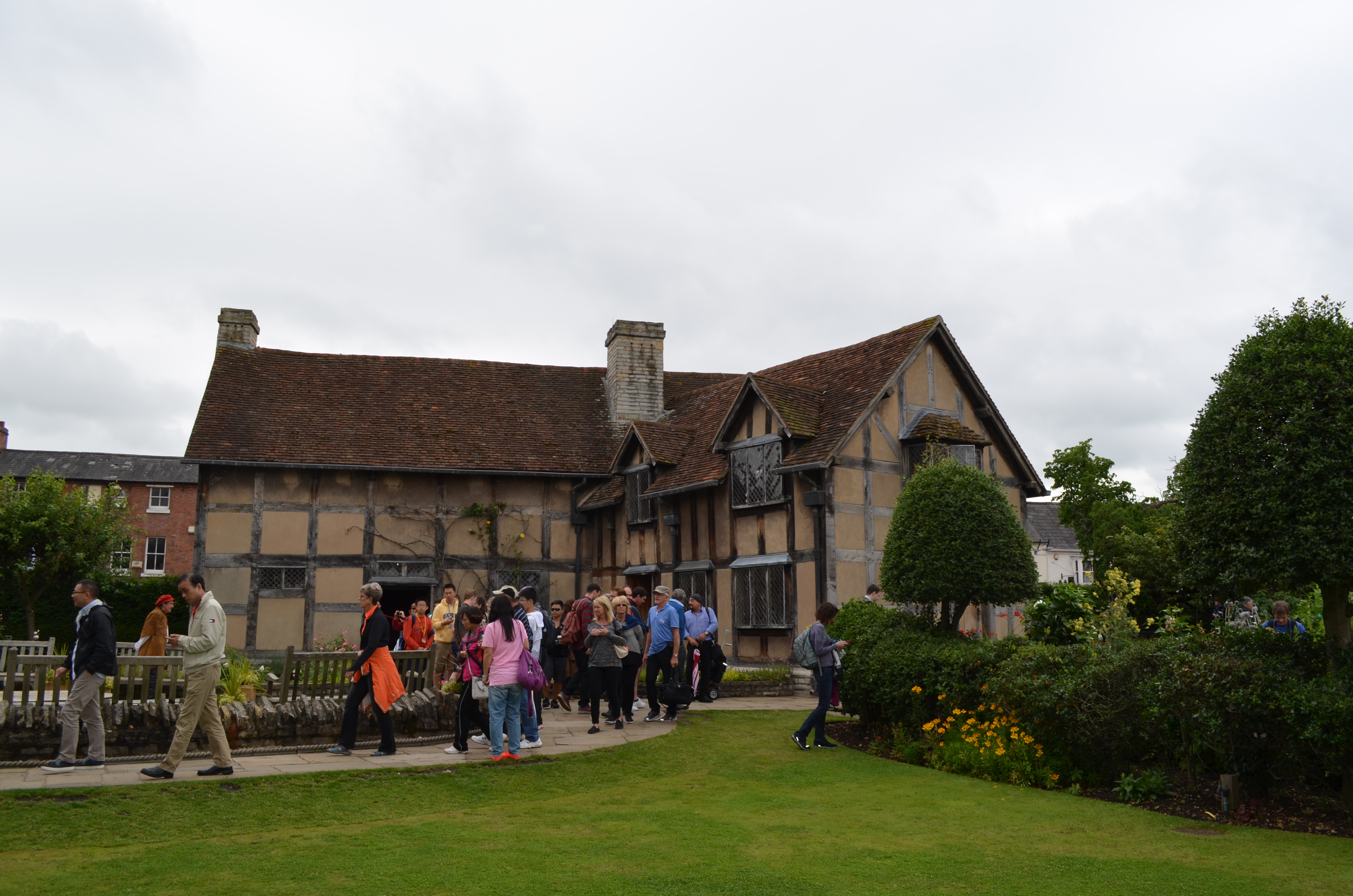
I walked all over Stratford-upon-Avon, visited Shakespeare’s birthplace, and spent hours listening to the “Shakespeare Aloud” players, who can recite and act many scenes from plays and sonnets on request. I placed my hand on the stone that used to be the marker at the centre of this lovely market town, a stone that Shakespeare surely would have touched and maybe sat upon – it is one of the few relics that we can be almost certain was touched by his hand.

The Shakespeare Aloud Players

The Shakespeare Aloud Players

We watched Henry IV part 2, brilliantly acted at the RSC, using a thrust stage (I was unaware that was what it was called until educated by Eve), which would have been the style used in Shakespeare’s time, bringing the actors into the audience and providing multiple points for dramatic exits and entries. To say I was entirely absorbed by the play, which though I have read I have never seen before, is an understatement.

The "thrust" stage at the RSC

The “thrust” stage at the RSC

On a rising tide of enthusiasm I began to write. A plot, a sub-plot, characters names and personalities forming in my mind, weaving twists and turns into my storyline taking inspiration from what I had seen and heard during my visit. The outline came together quickly, I found using a notebook and a pen was the best way to capture the rapid changes of direction that my brain is wont to do, the written story outline has become punctuated by scribbled diagrams to represent the plot, notes in the margin mark where I had a sudden realisation that I’d missed something or that more embellishment was needed. I was on a roll, I hadn’t written like this in years. I described my ideas to Eve – she is a great encouragement (also a little annoyed that I didn’t finish my last book as she’d enjoyed the first chapters that I had written for her) –  and  thought I had the makings of a good story. Always championing equality Eve has also reminded me of the Bechdel test – a recently developed test to guard against gender bias – does my work contain at least two women who talk to each other about something other than a man? I pass. As a result I’m now looking even more critically at what I write, what other “tests” should I apply? It’s no good having  what I think is a great story if it doesn’t have “reader appeal”. My preferred genre is historical fiction – the attraction is that they are always historically accurate – the unwritten rules seem to be that there must be several characters who actually existed during the period and the story must revolve around some real events. Authors of historical fiction tend to explain in the preface that their work is not an accurate account, some events may have occurred in a different order, and the conversations and actions of many of the characters are imagined – but nevertheless the historical context is correct. I have set about researching the techniques and approaches that authors use more thoroughly, looking at what I can “get away with”, mine is a tale that traverses two time periods – so my challenge is making it believable, but there are more examples of this style than I could have imagined – there is certainly no shortage of ideas. I am starting to think that I can write, that I should write, that I am a writer. I have been mistaken for being an “actual” writer twice now since I started this novel. It’s a case of mistaken identity but an identity I’d like to believe of myself. The first occasion was in discussion with the lighting director at the RSC, a thoroughly interesting chap, whose art is to bring the stage alive with different lighting techniques, during our conversation Eve mentioned I was writing a book, which interested him and, although I briefly tried to deny that I was a writer, as the conversation continued I found myself talking as if I was – more to the point he spoke to me as if I was too. The second occasion was surreal to say the least. Eve and I had returned to Stratford-upon-Avon a few weeks after her course so that she could meet  with the course director again as a follow-up. That left me with an afternoon to myself. Having an open ticket to Shakespeare’s Birthplace, I could think of no better location to sit and write further. I installed myself at a wooden table on the lawn outside the cafe, with the house as the backdrop, and ordered a pot of earl grey tea. I then got out my notebook and began to scribble away. I must have been writing for two hours without a break – it was a perfect day for writing, with the sun shining, and some natural dappled shade from the trees, an occasional light breeze preventing the heat from becoming uncomfortable. In the garden next to me I could hear the Shakespeare Aloud players reciting one well-known speech after another – as the audiences came and went I must have heard “Two households, both alike in dignity…” and the rest of the prologue from Romeo and Juliet at least a dozen times! I was just about to lay down my pen to listen more closely to one of my favourite speeches from the Merchant of Venice (Portia’s “The quality of mercy…”), when twenty or so Chinese tourists came into the garden, I thought nothing of it as this is a regular occurrence, and I sat back and tried to listen. It was then that a Chinese gentleman approached me, pointing excitedly at his iPhone, grinning widely and saying “please”. As I am from the tourist city of Cambridge this was not unusual to me, visitors often ask if you would mind taking a picture of them and their friends or family against a famous backdrop – so I went to take the iPhone from him. But no, this is not what he wanted, he wanted his picture taken with me. I tried to explain that I was nobody famous, just visiting here myself, they spoke no English so that explanation was pointless. I even tried in French – the only other language I am semi-fluent in – as someone later pointed out to me, that scene may have  appeared somewhat farcical if ever played back to me – an Englishman telling a group of Chinese in French that he is not famous! That wasn’t the end of it though, having had my picture taken with this gentleman the rest of the group started queuing – a very orderly queue – to do the same. I must have had my picture taken fifteen times either shaking hands with a Chinese gentleman, or with a Chinese lady leaning on my shoulder (their preferred poses, not mine!). All this time the cafe manager looked on from the balcony somewhat bemused, but finding it rather funny. All I can imagine is that they genuinely thought I was a well-known writer, placed there as a resident author for the tourists. I am still intrigued as to exactly who they thought I was and I can’t help but wonder what captions and titles will be on their photographs.

Shakespeare's Birthplace

Shakespeare’s Birthplace

Mistaken identity or not, I do feel more like a writer these days. I write most days. My day job is still the same, but in my head I am moving towards writing as a way of life. It will take some time, maybe I will never manage it professionally, but the more I write, the more I practice, and the more I get mistaken for being a writer, the more I feel that I could be one – no mistake! I wonder if my work will ever be translated into Mandarin…